.jpg)


Conceptual Framework
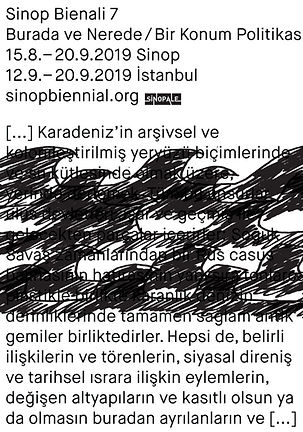
“Here and Where / A Politics of Location”
The Sinop Biennial is based on situated practices and collaborative processes. It finds a starting point at the former marketplace “Hal” in the center of Sinop, the northernmost coastal city of Türkiye, to explore various localities in the Anatolian Black Sea region. Moving on collective routes, the aim is to gather diverse histories, experiences, and artistic inquiries in situ: in the local geo- and socio-political realities, the Black Sea’s archival and colonized landforms and body of water. They pass over nation states and contain fragments from the past and future; the memory of a Russian spy whale from Cold War times, as well as perfectly intact ancient ships deep down in the dark sea together with tons of plastics. They are the site of particular relations and rites, of acts of political resistance and historical persistence; of changing infrastructures and movements from those who left and those who arrived—deliberately or not.
Modifying the idiom here and there, the title “here and where” refers to a place at the border of our perception and excluded from our dominant narratives. Yet, a place, where geopolitical and geo-cultural realities together with a history of material, linguistic, and mythological exchange shape a lived present. It implies a politics of location. Formulated by the feminist poet Adrienne Rich (1929–2012), a politics of location aims to reconnect thinking and speaking with a situated experience, a particularity, a geography, a body. The politics of location does not however take locality as the site of foundational knowledge; rather, it understands location as the place of experienced connections and intersections—through routes rather than roots. In that, the local begins, not with a bounded site but with historical contact, in relations and translations, and by displacements. The local takes place as an itinerary, a series of encounters, contacts, and conflicts, on routes that enable and discipline the movement of beings and things; where politics is situated.
Routes to follow at the Black Sea are: the Danube downstream into the Black Sea, Diogenes’ mythical travel from his hometown Sinop to Athens, the beltway connecting the six neighbors around the coast, the flows of oil, trash, data, swarms and pheromones from the Bosporus; to follow some of these routes might help us understand location as the relationship between things and beings.
While the biennial establishes contact zones on routes that are traversed by things and beings, it is concerned with the potentials of discrepant movement, with tactics of translation and transgression, with encounters as political and aesthetic impulse. It aims to initiate active contacts and processes, establish collective practices between residents, guests, and the (sub)urban region; it aims at art being produced rather than placed there. Through transversal processes of conversation, translation and improvisation the biennial engages in questions of possible other and emancipated ways of connecting to things and beings, of recognizing and collectively producing alternative forms of knowledge with guests, the local environment and its inhabitants (animals, humans, plants, technology).
To move these forms of knowledge from the Black Sea Coast to Istanbul and other places, we will produce an open and nomadic archive. There, the situated practices and collaborative processes will be continued and shared.
Curators
Artists
Adelheid Schulz, Ana Filipovic & Philipp Mecke, Annika Eriksson, Banu Cennetoğlu, Cornelia Lund ve Holger Lund (fluctuating images, Berlin), Çağla Sönmez Çakır, Fulya Erdemci & Kevser Güler, Hayırlı Evlat, Johannes Vogl, Kemal Özen, Mahir Namur, Mehtap Baydu, Misal Adnan Yıldız, Mobile Albania, Nil İlkbaşaran & Güngör Erdem, Övül Ö. Durmuşoğlu, Pınar Öğrenci, Şener Özmen, The Dynamic Archive
Team
Management, Organization, Applications, Budgeting: Aslı Serbest & Mona Mahall
Curatorial Assistance: Ezgi Çiftçi
Production: Mert Karaçıkay
Production Management: Erkan Akliman
Media and Press Relations: Yiğit Kaya
Press / Social Media: Aslı Serbest & Mona Mahall
Website: Aslı Serbest & Mona Mahall
Illustrations: Aslı Serbest & Mona Mahall ve sanatçı Alexander Pfeiffenberger
Translation: Aslı Serbest, Ezgi Çiftci, Çiğdem Girgiç
Corporate Identity Design: Umut Südüak
Photography: Laura Baumann, Yusuf Emre Yalçın
Volunteer Team: İbrahim Hekim, Yusuf Emre Yalçın, Cansu Kırcan, Çağatay Şimşek, Chada El Ward Mazigh, Selin Saraçoğlu, Elif Yılmazer, Yağmur Güzle, Doğa Burak Hayırcı, Oğulcan Övet
Venues
1. Hal, Sinop Meeting Center
2. Sabahattin Ali Cultural Center (Old Ice Factory)
3. Sinop City Center
Video


Images






Supporters
